
Table Of Contents
This NASA mission delivered vital data on Earth’s radiation belts and concluded safely today with minimal risk.
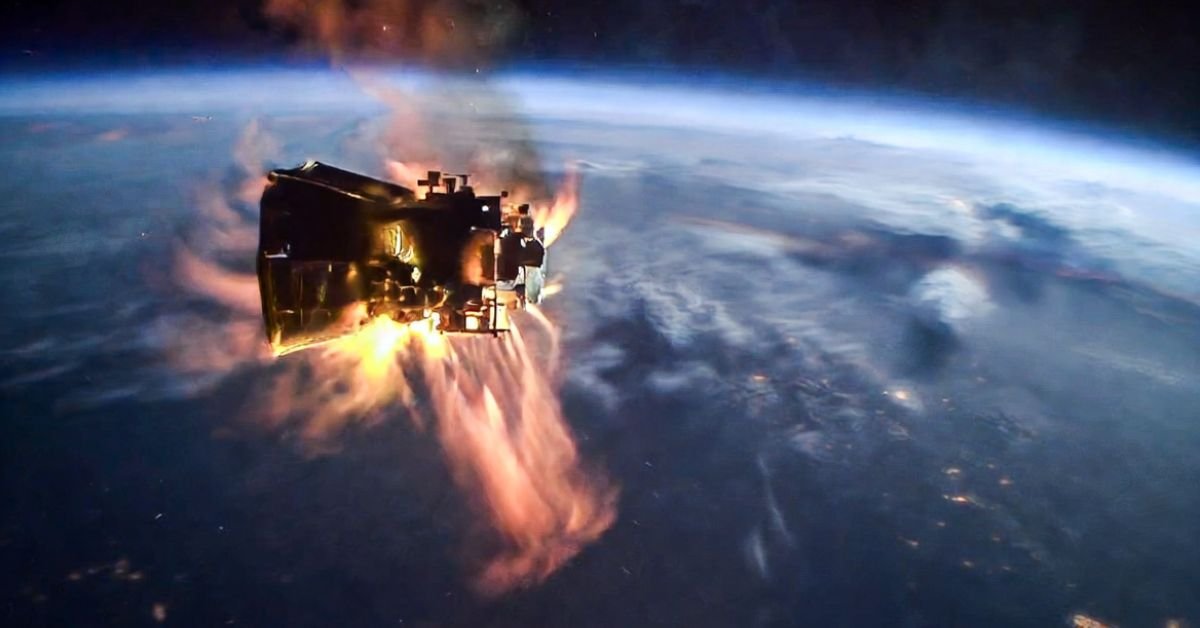
NASA Satellite Crash: Van Allen Probe A Re-Entry Today
Headlines about a NASA satellite crash refer to the controlled atmospheric re-entry of Van Allen Probe A.
On March 10, 2026, the spacecraft is expected to re-enter Earth’s atmosphere around 7:45 p.m. Eastern Time, within a 24-hour window.
After nearly 14 years of operation, the probe has exhausted its fuel and is descending under gravity.
The majority of the 1,300-pound satellite will burn up during re-entry in accordance with established NASA protocols.
The Van Allen Probes Mission
NASA launched two identical spacecraft, Probes A and B, in August 2012.
Their purpose was to study the Van Allen radiation belts, two doughnut-shaped regions of charged particles trapped by Earth’s magnetic field.
These belts, located between 600 and 37,000 miles above the surface, shield Earth from solar radiation while posing hazards to satellites and astronauts.
The probes were built to withstand intense radiation levels that would damage standard electronics, allowing them to collect direct measurements inside the belts.
Major Scientific Contributions
The mission far exceeded its planned two-year duration, operating effectively until 2019 and continuing limited observations afterward.
Among its key discoveries was the temporary formation of a third radiation belt during a powerful solar storm in 2012, a phenomenon never before observed in detail.
The probes also clarified how electrons and ions in the belts can accelerate to near-light speeds, providing critical data for space weather forecasting.
These insights help protect power grids, GPS systems, aviation, and communication networks from the effects of solar events.
Mission Specifications
| Feature | Details |
|---|---|
| Launch Date | August 30, 2012 |
| Spacecraft Weight | Approximately 1,300 pounds (590 kg) |
| Primary Objective | Study Earth’s radiation belts |
| Operational Period | 2012–2019 (extended data collection) |
| Expected Re-Entry | March 10, 2026, ~7:45 p.m. ET |
| Public Safety Risk | Extremely low (approximately 1 in 4,200) |
Re-Entry Safety and Procedures
NASA has determined that the risk of any debris reaching populated areas is negligible.
Atmospheric friction will generate temperatures high enough to vaporize most components.
Any surviving fragments are expected to land in remote ocean regions, which cover more than 70 percent of Earth’s surface.
This planned re-entry demonstrates responsible space operations and aligns with international guidelines for limiting orbital debris.
Interesting Trivia
The radiation belts were discovered in 1958 by physicist James Van Allen using instruments aboard Explorer 1, America’s first satellite. The probes bearing his name have now delivered the most comprehensive dataset ever assembled on these protective zones, extending a scientific legacy that began nearly seven decades earlier.
Conclusion
The re-entry of Van Allen Probe A marks the successful conclusion of a landmark NASA mission that advanced scientific understanding of near-Earth space.
Its findings continue to support safer satellite operations and future human exploration beyond Earth.
Readers seeking additional details on NASA missions, space weather, or ongoing developments in space exploration are encouraged to explore other articles on the website.
About Author