
Table Of Contents
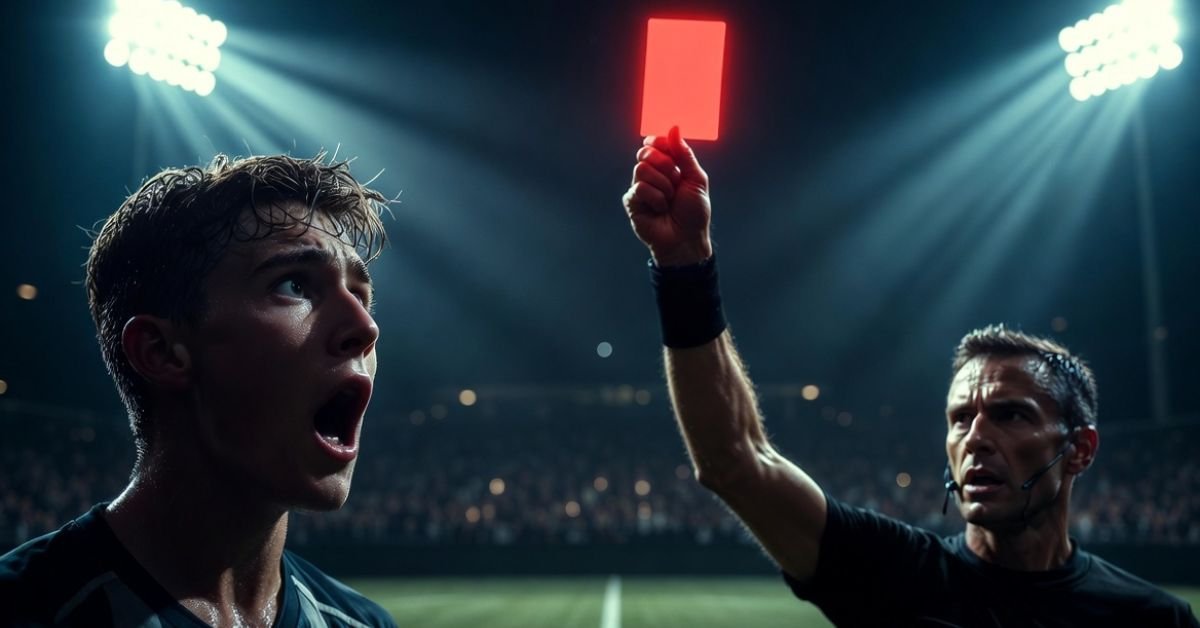
Every major soccer tournament produces at least one moment when a referee reaches into a pocket, raises a red card, and changes the course of a match.
Millions of viewers then ask the same questions.
What exactly did the player do?
Why can’t anybody replace him?
Will he miss the next game?
This guide answers all of those questions in one place.
The rules explained here come from the Laws of the Game, the rulebook maintained by the International Football Association Board (IFAB).
These laws apply at every level of the sport, from local leagues to the FIFA World Cup.
What A Red Card Means
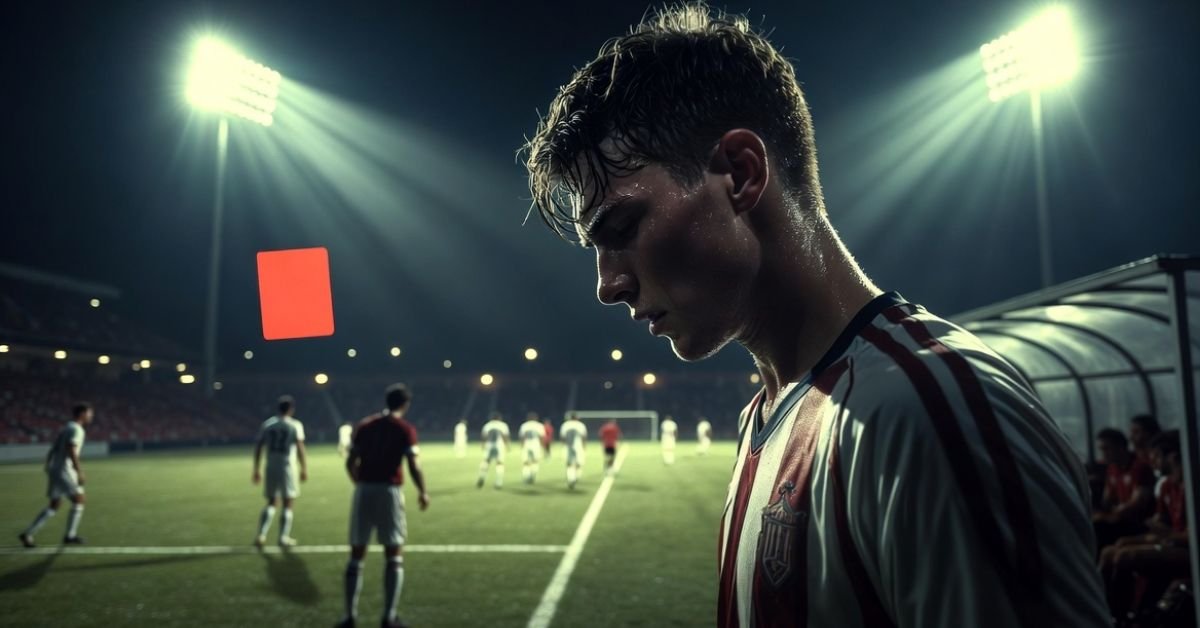
A red card is the most severe punishment a referee can give a player during a match.
It is officially called a sending-off or a dismissal.
When a player receives a red card, three things happen immediately.
First, the player must leave the field of play at once and cannot remain on the bench or in the technical area.
Second, the player cannot be replaced, so the team must finish the match with one fewer player than it started with.
Third, the player faces a suspension that carries into future matches, which we explain later in this guide.
A red card can also be shown to coaches and other team officials for misconduct on the touchline, although in that case, the team does not lose a player on the field.
The Two Ways To Receive A Red Card
There are two routes to a dismissal.
A straight red card occurs when the referee judges that a single offense is serious enough to merit an immediate sending-off.
A second yellow card produces an automatic red card.
A player who receives two yellow cards, called cautions, in the same match is shown a red card and dismissed.
Two moderate offenses add up to one dismissal.
Offenses That Earn A Straight Red Card
The Laws of the Game list the specific offenses that require a straight red card.
They are presented below.
Serious foul play covers a challenge for the ball that uses excessive force or endangers the safety of an opponent.
Studs-up lunges and high challenges into an opponent’s leg or ankle fall into this category.
Violent conduct involves using excessive force or brutality against any person when not challenging for the ball.
Punches, elbows, kicks, and headbutts belong here.
Spitting at or biting any person also results in a straight red card.
Denying an obvious goal-scoring opportunity by handling the ball leads to dismissal.
This applies to outfield players and to goalkeepers who handle the ball outside their own penalty area.
Denying an obvious goal-scoring opportunity with a foul, often called a professional foul, results in a red card.
If a defender drags down a striker who is clean through on goal, the defender is dismissed.
There is one softening clause: if the foul occurs inside the penalty area and the defender was making a genuine attempt to play the ball, the punishment is a penalty kick and a yellow card rather than a red card.
Using offensive, insulting, or abusive language or gestures results in a red card.
This includes discriminatory abuse, which soccer’s governing bodies treat with particular severity.
Entering the video operation room where the VAR officials work also earns a straight red card.
This is a modern addition to the laws.
What Happens After The Match: Suspensions
A red card always brings a suspension, and the length depends on the offense and the competition.
The standard baseline across world soccer is an automatic one-match ban.
A player dismissed for a second yellow card or for a professional foul typically misses one game.
Serious offenses bring longer bans.
In most competitions, violent conduct carries a suspension of around three matches, and spitting or biting can bring a suspension of six or more.
National associations and confederations publish their own disciplinary codes, but the pattern is consistent everywhere: the worse the offense, the longer the ban.
Suspensions apply to the same competition in which the card was shown.
A player sent off in a domestic cup normally serves the ban in that cup while remaining available for league matches, depending on the rules of the association concerned.
One further point surprises many fans.
A red card suspension does not expire when a tournament ends.
If a player is dismissed in the final match of a World Cup or a continental championship, the ban carries over to the team’s next competitive fixture.
Can A Red Card Be Appealed Or Overturned?
This is one of the most searched questions in the sport, and the answer is rarely, and only in narrow circumstances.
Most competitions allow a claim of mistaken identity.
If the referee cautions or dismisses the wrong player, the punishment can be transferred to the correct one.
Many domestic leagues also allow a claim of wrongful dismissal for straight red cards.
An independent panel reviews the video evidence, and if the appeal succeeds, the suspension is withdrawn.
The English Premier League is a well-known example of a competition with this process.
FIFA tournaments are stricter.
At the World Cup, the automatic one-match ban that follows a red card cannot be appealed or cancelled.
An appeal is possible only if the FIFA Disciplinary Committee extends the suspension beyond one match; otherwise, the team may challenge only the extension, not the original card.
Coaches and players regularly express frustration with this rule, but it has remained firmly in place.
What a red card rarely does is get reversed because fans, pundits, or even the referee later feel the decision was harsh.
Governing bodies protect the authority of the match officials, and judgment calls stand.
The Role Of VAR In Red Card Decisions
Since the introduction of the video assistant referee, red cards have become one of the four match-changing situations that VAR is allowed to review.
The others are goals, penalties, and mistaken identity.
VAR works in two directions.
It can recommend a red card the referee missed and advise the referee to withdraw a red card issued in error.
In both cases, the referee usually walks to a pitchside monitor, reviews the footage, and makes the final decision personally.
VAR intervenes only for clear errors.
It does not re-referee every tackle, and it cannot review yellow cards except when a second yellow leads to a dismissal due to mistaken identity.
Critics note one recurring problem.
Slow-motion replays can make accidental contact look deliberate and violent.
Referees are trained to judge the point of contact in slow motion but the intent and intensity at full speed.
Whether that balance is struck correctly remains one of the liveliest debates in modern soccer.
Red Cards At The FIFA World Cup: Quick Answers
Because World Cup matches attract millions of casual viewers, the same questions trend every four years.
Here are the direct answers.
What happens when a player gets a red card at the World Cup?
He leaves the field at once, his team plays the rest of the match with one fewer player, and he receives an automatic ban for at least the next match.
Can the team appeal?
No. The automatic one-match ban is final. Only an extended ban can be challenged.
Does the ban apply even in knockout rounds?
Yes. A player sent off in one knockout match misses the next, no matter how important it is.
Do yellow cards also cause suspensions?
Yes. A player who collects yellow cards in two different matches serves a one-match ban. FIFA wipes single yellow cards at a set stage late in the tournament so that no player misses the final through accumulation alone.
How long is a World Cup match?
Ninety minutes plus stoppage time. Knockout matches that end level go to 30 minutes of extra time, then a penalty shootout. A red card does not shorten or lengthen the match.
Famous Red Cards In History
A few dismissals have become part of soccer folklore.
Zinedine Zidane received the most infamous red card of all in the 2006 World Cup final, when the French captain headbutted Italian defender Marco Materazzi in extra time of the last match of his career.
David Beckham was sent off against Argentina at the 1998 World Cup for flicking a boot at Diego Simeone, and endured a year of national fury in England before redeeming himself.
Luis Suarez of Uruguay was dismissed in the 2010 World Cup quarterfinal for deliberately handling the ball on the goal line against Ghana, a red card that arguably saved his team, since Ghana missed the resulting penalty and Uruguay advanced.
Trivia Corner
The red and yellow card system was invented by English referee Ken Aston, who reportedly came up with the idea while sitting at a traffic light in London. Yellow for caution, red for stop. The cards were used for the first time at the 1970 World Cup in Mexico, yet remarkably, no red card was shown during that entire tournament. The first World Cup red card was shown to Chile’s Carlos Caszely in 1974.
Final Word
The red card exists to protect players and to protect the game.
One flash of red rebalances a match, tests the depth of a squad, and often defines a tournament.
The next time a referee points to the tunnel, you will know exactly what it means, why nobody can replace the dismissed player, and why the suspension that follows is almost always final.
Did we miss a red card question you have always wondered about?
Tell us in the comments below, and stay with us for clear, reliable explainers on the rules that shape world sport.
About Author
