
Table Of Contents
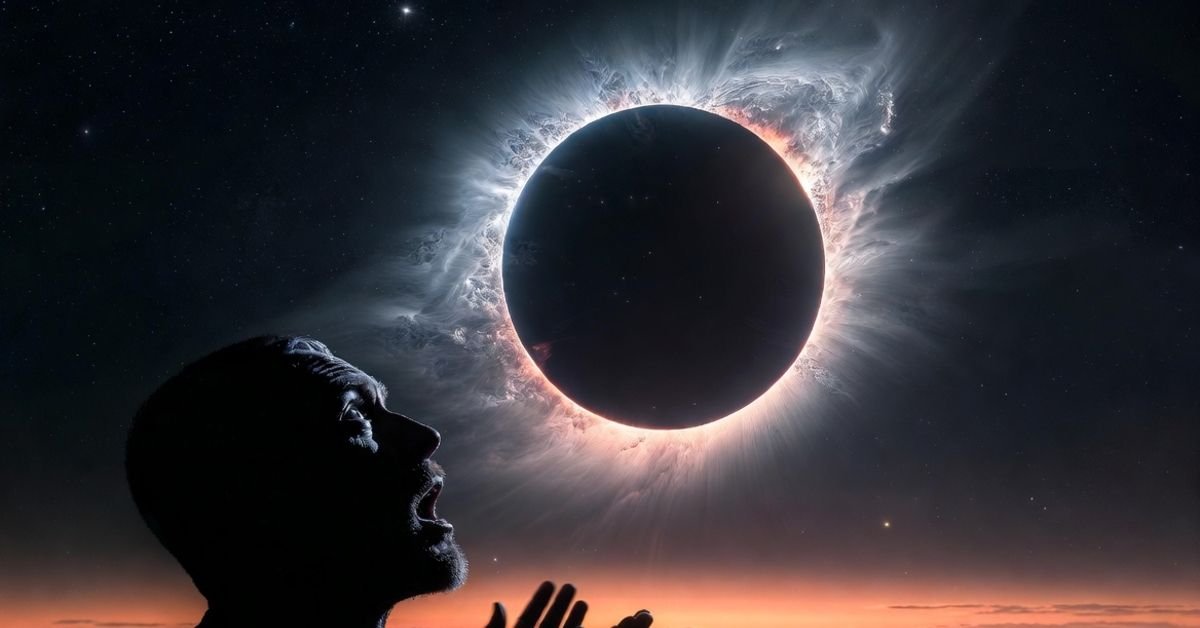
Few natural events stop the world quite like a total solar eclipse. Traffic pulls over. Cities go quiet. For a couple of minutes, the day turns to an eerie twilight, stars appear, and the Sun’s ghostly outer atmosphere, invisible at any other time, hangs in the sky like a silver crown. People who have seen one almost universally describe it the same way: photographs do not come close.
With the next total solar eclipse crossing Iceland and Spain on August 12, 2026, and the longest eclipse of the century following in 2027, this guide explains the science, the safety rules, the upcoming dates, and, for readers in India and the Gulf, exactly how to plan to see one.
What Actually Happens During A Solar Eclipse
A solar eclipse occurs when the Moon passes directly between the Earth and the Sun, casting its shadow onto our planet’s surface. The Moon’s shadow has two parts, and which part you stand in determines everything about your experience.
- The penumbra is the broad outer shadow. From inside it, the Moon covers only part of the Sun; this is a partial eclipse. Interesting, but the sky barely darkens, and you need eye protection the entire time.
- The umbra is the small, dark inner core of the shadow, often only 100–250 kilometres wide at its point of contact with Earth. Only from inside the umbra do you witness totality: the Moon completely covering the Sun’s disk. The umbra races across the Earth’s surface along a narrow track called the path of totality, and this path is the only place the full spectacle occurs.
This is the single most important fact about eclipses, and the one first-timers most often get wrong: a 99% partial eclipse is not 99% of the experience. The difference between 99% coverage and totality is, quite literally, night and day. Only within the path of totality does the sky go dark, the stars come out, and the corona appear.
The Cosmic Coincidence That Makes It Possible
Total solar eclipses exist because of an astonishing accident of geometry. The Sun’s diameter is about 400 times that of the Moon’s, and the Sun is about 400 times farther away. As a result, the two bodies appear almost the same size in Earth’s sky.
No other planet in the solar system enjoys this coincidence. Mars’s moons are far too small; Jupiter’s are the wrong size at the wrong distances. Earth is the only place where a moon can cover its star so precisely that the star’s atmosphere becomes visible around the edges.
It is also a temporary gift. NASA’s lunar laser-ranging measurements show the Moon drifting away from Earth by roughly 3.8 centimetres per year. In the distant future, hundreds of millions of years from now, the Moon will appear too small to fully cover the Sun, and total eclipses will cease forever. We happen to live in an era when geometry is perfect.
Why Eclipses Do Not Happen Every Month
The Moon orbits Earth every month, so why isn’t there an eclipse every new Moon? Because the Moon’s orbit is tilted about five degrees relative to Earth’s orbit around the Sun. Most months, the new Moon passes slightly above or below the Sun in the sky, and its shadow misses Earth entirely.
Only when a new moon coincides with the points where the two orbital planes cross, the “nodes”, does the alignment work. This happens during “eclipse seasons” roughly every six months, producing at least two solar eclipses somewhere on Earth each year. However, most are partial or fall over the remote ocean. A total eclipse crosses any given city, on average, only about once every 360–400 years. That is why people travel across the world to stand in the shadow.
What You See During Totality
Totality is a sequence of distinct phenomena, each lasting seconds:
- The diamond ring: In the final moment before totality, the last sliver of sunlight blazes through a lunar valley, creating a brilliant point of light on a glowing ring.
- Baily’s beads: Sunlight breaking through the rugged terrain along the Moon’s edge produces a string of shimmering beads.
- The corona: With the Sun’s blinding surface hidden, its outer atmosphere, a halo of plasma streaming millions of kilometres into space, becomes visible to the naked eye. This is the sight people chase across continents.
- The 360-degree sunset: Because the umbra is small, the horizon in every direction lies outside the shadow, glowing with sunset colours all around you.
Temperatures drop noticeably. Birds fall silent or roost. Planets and bright stars appear. Then, after anywhere from a few seconds to about seven minutes, depending on the eclipse, the diamond ring flashes on the opposite edge and daylight floods back.
How To Watch A Solar Eclipse Safely
The rules are simple and absolute. During every partial phase, before and after totality, or anywhere outside the path, looking at the Sun without certified protection can permanently damage your retina, which has no pain receptors to warn you.
Use eclipse glasses that meet the ISO 12312-2 international standard and are purchased from suppliers vetted by the American Astronomical Society. Ordinary sunglasses, smoked glass, exposed X-ray film, and phone camera filters are all unsafe, including the traditional darkened-glass methods still sometimes used in India during eclipses. A simple pinhole projector, a small hole in a card projecting the Sun’s image onto a wall or the ground, is a safe, indirect method that costs nothing.
The one exception: during totality itself, when the Sun’s disk is fully covered, it is safe, and essential, to look with the naked eye. The corona is about as bright as a full moon. The moment the Sun begins to reappear, protection goes back on.
Upcoming Total Solar Eclipses: 2026, 2027, 2028, and Beyond
| Date | Path Of Totality | Notes |
|---|---|---|
| August 12, 2026 | Arctic, Greenland, western Iceland, northern Spain | Europe’s first total solar eclipse in decades; totality near sunset in Spain |
| August 2, 2027 | Southern Spain, North Africa, Arabian Peninsula (including Saudi Arabia and Yemen) | One of the longest of the century, >6 minutes near Luxor, Egypt; excellent weather |
| July 22, 2028 | Australia (directly over Sydney), ending in New Zealand | Strong urban viewing opportunity |
| November 25, 2030 | Southern Africa and Australia | Later option |
For any given reader, the practical question is always the same: find the path of totality, and get inside it. Ninety-nine percent is zero percent.
Will A Total Solar Eclipse Be Visible From India?
Here is the honest answer Indian readers are searching for: not soon. India last experienced a total solar eclipse in July 2009, when totality crossed Surat, Bhopal, Varanasi, and Patna at dawn. The country has seen dramatic annular (“ring of fire”) eclipses, notably in December 2019 across Kerala and Tamil Nadu. However, the next total solar eclipse visible from Indian soil is not until March 20, 2034, when totality clips the far north of the country (primarily parts of Jammu and Kashmir).
That leaves travellers with two options: wait eight years, or go to the eclipse.
The 2027 Eclipse: The Best Travel Opportunity For Indians And Gulf Residents
For anyone in India or the Gulf, the August 2, 2027, eclipse is the one to plan for, arguably the most accessible great eclipse of a generation. (For practical planning tips, see more on TRAVEL WITH THOUSIF.)
- It passes close to home: The path of totality crosses Egypt (with Luxor getting over six minutes of totality, near the maximum possible), Saudi Arabia (including areas near Jeddah and Mecca), and Yemen. For the millions of Indians living and working in the UAE, Saudi Arabia, and Qatar, the eclipse path is a short regional flight away, for some Saudi residents, a drive.
- The weather is nearly guaranteed: Egyptian and Arabian desert skies in August are among the most reliably cloud-free viewing conditions anywhere. Compare that with eclipse chasers who have flown across the world only to stand under clouds.
- It combines with iconic travel: Luxor, the ancient Thebes, home to Karnak Temple and the Valley of the Kings, sits almost exactly on the centreline. A total eclipse over the temples of ancient Egypt is likely to be one of the most photographed events of the decade, and accommodation will sell out far in advance. If you intend to go, 2026 is the year to book, not 2027.
- Direct flights connect Indian metros and Gulf hubs to Cairo, with onward connections to Luxor. Egyptian tourist visas are routine for Indian passport holders, and Saudi Arabia’s tourist e-visa has opened a new path as a genuine alternative.
Why Eclipses Still Matter To Science
Eclipses are not just a spectacle. The corona remains one of the Sun’s great unsolved puzzles; it is millions of degrees hotter than the solar surface below it, a paradox that physicists are still working to explain fully. Totality offers a natural laboratory for studying it. Historically, eclipses have delivered landmark discoveries: helium was first detected in the Sun’s spectrum during the 1868 eclipse, observed from Guntur in India, which is how the element came to be found in the heavens before it was found on Earth. Moreover, the 1919 eclipse famously provided the first observational confirmation of Einstein’s general relativity, when starlight was measured bending around the Sun exactly as the theory predicted.
The Bottom Line
A total solar eclipse is the rarest kind of natural wonder: precisely predictable, completely safe to anticipate, and utterly overwhelming to witness. The mechanics are simple: a moon, a star, and a shadow, but the alignment that makes it possible exists nowhere else we know of. If you are in India or the Gulf, mark August 2, 2027: the shadow of the Moon will pass closer to you than it will again for many years. The universal advice from those who have stood inside it is one word: go.
About Author
