
Table Of Contents
A Significant Development In Easter Island Research
Recent scientific analysis has cast new light on one of the Pacific’s most intriguing archaeological puzzles.
Easter Island, or Rapa Nui, has long fascinated scholars and the public alike with its monumental moai statues.
Now, attention has turned to its mysterious Rongorongo script, with evidence suggesting the carved tablets may have originated well before the first documented European contact in 1722.
This development offers valuable insights into the intellectual achievements of an isolated Polynesian society and prompts a reassessment of how writing systems emerge in human history.
Understanding Rongorongo
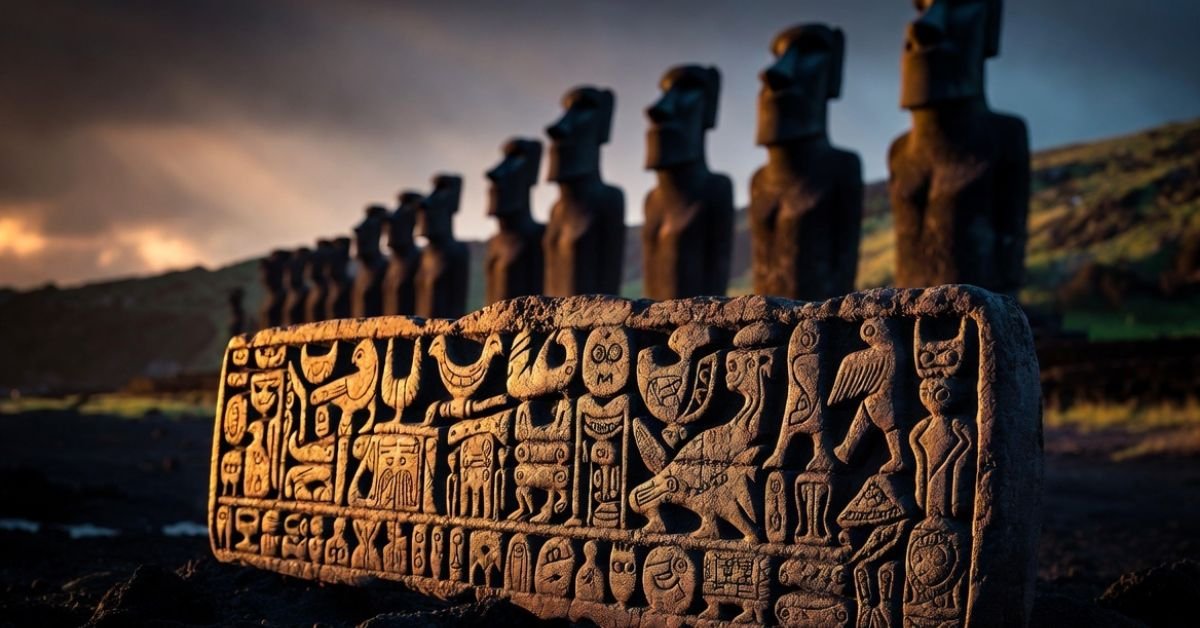
Rongorongo consists of a distinctive set of pictorial glyphs depicting birds, human figures, plants, marine life, and geometric forms.
The script is inscribed on wooden tablets known as kohau rongorongo.
It follows a boustrophedon pattern, alternating directions with each line, much like the motion of an ox plowing a field.
The term “Rongorongo” itself roughly translates as “to recite” or “to chant,” suggesting the tablets were likely used to record oral traditions, genealogies, or ceremonial knowledge.
Fewer than thirty authentic examples remain today, preserved in museums worldwide.
The glyphs bear no resemblance to any other known writing system, raising longstanding questions about their origins.
Many experts have speculated that Rongorongo represents one of the rare independent inventions of writing, a phenomenon documented only a handful of times throughout human civilization.
The Key Findings From Silvia Ferrara’s Team
In a detailed 2024 study, Silvia Ferrara of the University of Bologna and her colleagues applied radiocarbon dating to four Rongorongo tablets housed in Rome.
Three tablets were fashioned from wood harvested after European contact.
However, one tablet, known as the “Échancrée”, was carved from a tree felled between 1493 and 1509, more than two centuries before the arrival of Dutch explorer Jacob Roggeveen.
This dating is particularly noteworthy because fresh timber is generally preferred for precise carving.
The researchers conclude that the inscriptions were most likely made shortly after the wood was obtained, providing compelling circumstantial evidence that Rongorongo was already in use during the island’s pre-contact period.
While the sample size remains limited, the results represent a meaningful step forward in understanding the script’s timeline.
Implications For Global History
Should further research confirm these findings, Rongorongo would join an elite group of independently developed writing systems, alongside those of ancient Mesopotamia, Egypt, China, and Mesoamerica.
Such a discovery would highlight the remarkable capacity for cultural innovation among the Rapa Nui, who thrived on one of the world’s most remote inhabited islands.
It also challenges earlier assumptions that complex innovations, such as writing, necessarily diffused from larger continental societies.
Instead, it underscores the potential for original intellectual accomplishments even in small, isolated communities.
Historical Context At A Glance
The following table summarizes key milestones in Rapa Nui history to provide a clearer perspective:
| Period | Key Event | Significance |
|---|---|---|
| c. 1200 CE | Polynesian settlement by voyaging canoes | Establishment of the Rapa Nui culture |
| 1400–1650 CE | Height of the moai statue construction | Demonstration of advanced engineering |
| 1493–1509 CE | Wood harvested for one Rongorongo tablet | Earliest evidence of possible writing |
| 1722 CE | First European contact by Jacob Roggeveen | End of complete isolation |
| 19th century | Population decline following external pressures | Period of significant challenge |
An Intriguing Fact
Easter Island is situated more than 2,000 kilometres from the nearest inhabited landmass, making it one of the most remote inhabited places on Earth. Despite this profound isolation, its people developed not only the iconic moai but possibly an entirely original writing system, testament to human ingenuity under challenging circumstances.
Final Thoughts
This latest research into Rongorongo enriches our appreciation of the Rapa Nui’s enduring legacy and reminds us how much remains to be discovered about humanity’s past.
Thank you for reading.
We encourage you to explore our other articles on ancient civilizations, archaeological breakthroughs, and cultural heritage for more compelling stories.
Your thoughts and suggestions for future topics are always welcome.
About Author