
Table Of Contents
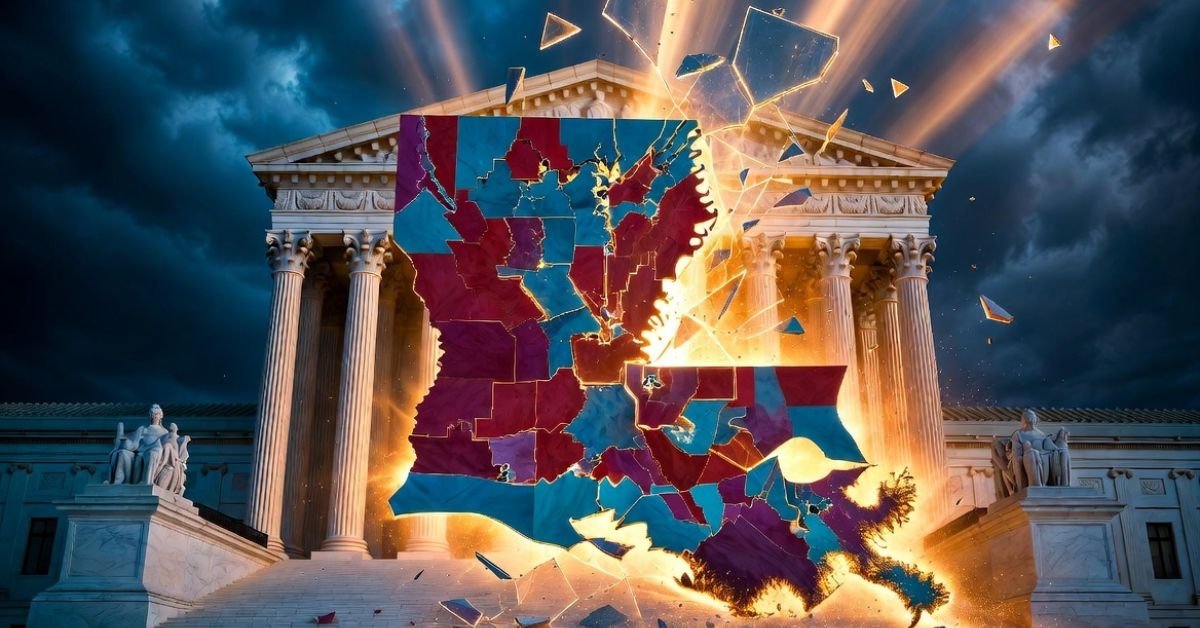
In a landmark 6-3 decision handed down on April 29, 2026, the US Supreme Court struck down Louisiana’s congressional redistricting map, ruling that it violated the Constitution by relying too heavily on race.
The case, Louisiana v. Callais, centered on whether the state’s 2024 map, which created a second majority-Black congressional district, complied with the Voting Rights Act of 1965 or crossed into unconstitutional racial gerrymandering.
Background Of The Case
Following the 2020 census, civil rights groups challenged Louisiana’s original congressional map under Section 2 of the Voting Rights Act.
With Black residents comprising approximately one-third of the state’s population, a federal court found that the map diluted Black voting strength by concentrating most Black voters into a single district.
In 2024, the Louisiana legislature responded by passing Senate Bill 8, creating a second majority-Black district.
This new map gave Black voters a realistic opportunity to elect their preferred candidates in two of Louisiana’s six congressional districts.
One of those districts successfully elected Democrat Cleo Fields.
A group of voters led by Phillip Callais filed suit, arguing that the map made race the predominant factor in violation of the Equal Protection Clause of the Fourteenth Amendment.
The Supreme Court’s Decision
Justice Samuel Alito, writing for the majority, held that Section 2 of the Voting Rights Act did not require Louisiana to draw the additional majority-Black district.
The Court concluded that the map constituted an unconstitutional racial gerrymander because race was the dominant consideration without sufficient justification.
The ruling affirms a lower court’s earlier decision and sends the case back to Louisiana for the legislature to redraw the state’s congressional districts.
Justice Clarence Thomas wrote a concurring opinion, while Justice Elena Kagan authored a strongly worded dissent joined by Justices Sonia Sotomayor and Ketanji Brown Jackson.
Here are the key details of the ruling:
| Aspect | Details |
|---|---|
| Case Name | Louisiana v. Callais |
| Decision Date | April 29, 2026 |
| Vote | 6-3 |
| Majority Opinion | Justice Samuel Alito |
| Holding | Louisiana’s second majority-Black district ruled an unconstitutional racial gerrymander |
| Impact | Narrow use of race in redistricting under the Voting Rights Act |
Implications For Voting Rights And Redistricting
The Voting Rights Act of 1965 remains one of America’s most important civil rights laws, designed to protect minority voters from discrimination.
This Supreme Court decision does not overturn the Act but significantly tightens the standards for when states may consider race when drawing electoral maps to prevent vote dilution.
For Louisiana, the ruling means the state will likely revert to a map featuring only one majority-Black district ahead of future elections.
Nationally, the decision may make it more challenging for minority groups to secure additional majority-minority districts in states with racially polarized voting patterns, while giving states greater flexibility in traditional redistricting criteria.
Historical Context
The Voting Rights Act was signed into law by President Lyndon B. Johnson in August 1965, just five months after the historic Bloody Sunday march in Selma, Alabama.
In the years following its passage, Black voter registration in the South increased dramatically, from under 30% to over 60%, highlighting the law’s profound impact on American democracy.
Looking Ahead
This ruling marks another significant development in the evolving landscape of voting rights law in the United States.
As states adjust their maps and legal experts analyze the new standards, the decision is expected to influence redistricting battles for years to come.
Voters and policymakers alike will be watching closely to see how this latest Supreme Court decision shapes representation in Congress and state legislatures nationwide.
About Author