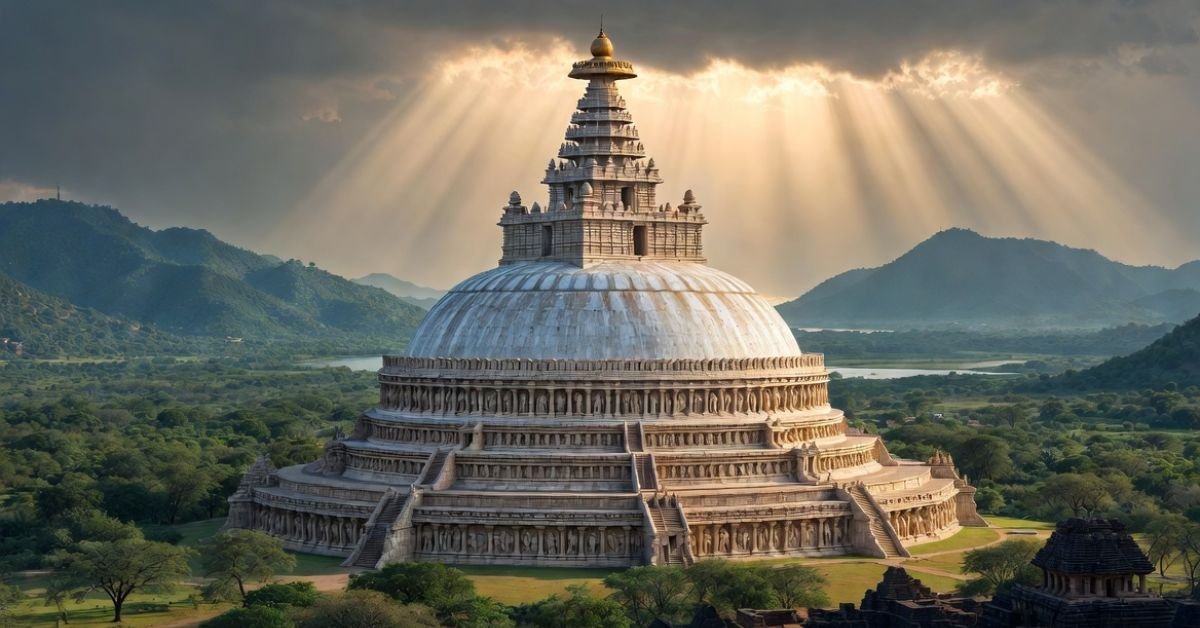

The Andhra Pradesh government continues to accord top priority to developing a comprehensive Buddhist Heritage Tourist Circuit as part of its cultural and spiritual tourism push.
Tourism and Culture Minister Kandula Durgesh had informed the State Legislative Assembly in February that the government would create an integrated circuit linking the state’s most important ancient Buddhist sites, including Amaravati, Nagarjunakonda, Ghantasala, Adurru, Thotlakonda, and Bavikonda.
The state is also accelerating archaeological excavations at several Buddhist locations and has sought central government assistance to upgrade these heritage sites to international standards.
Ancient Andhra Pradesh was one of the most significant centres of Buddhism in southern India from the 3rd century BCE to the 5th century CE.
The region thrived under the Satavahana and Ikshvaku dynasties, which extended strong patronage to Buddhist institutions.
This period saw the creation of grand stupas, monasteries, and some of the finest Buddhist art in the country.
The Amaravati Mahachaitya, located on the banks of the Krishna River, was once among the largest and most magnificent Buddhist stupas in India, celebrated for its exquisite limestone carvings that defined the renowned Amaravati School of Art.
Nearby Nagarjunakonda emerged as a major monastic university complex and is historically linked to Acharya Nagarjuna, the founder of the Madhyamaka school of Mahayana Buddhism.
Other important sites, such as the hilltop monasteries of Thotlakonda and Bavikonda near Visakhapatnam, along with Ghantasala and Adurru, underscore the deep roots of Buddhism in coastal Andhra and its ancient maritime connections with Sri Lanka and Southeast Asia.
Historians record that several early Buddhist sects maintained a strong presence in the region.
The government’s initiative is part of a broader strategy to place Andhra Pradesh on India’s Buddhist tourism map firmly.
Officials expect the circuit to draw both domestic pilgrims and international tourists interested in Buddhist history and heritage.
The project is also expected to improve infrastructure, connectivity, interpretation centres, and visitor facilities at these historically significant locations.
This sustained focus is being seen as a significant step towards preserving and promoting Andhra Pradesh’s rich yet relatively under-recognised contribution to India’s ancient Buddhist civilisation.
About Author