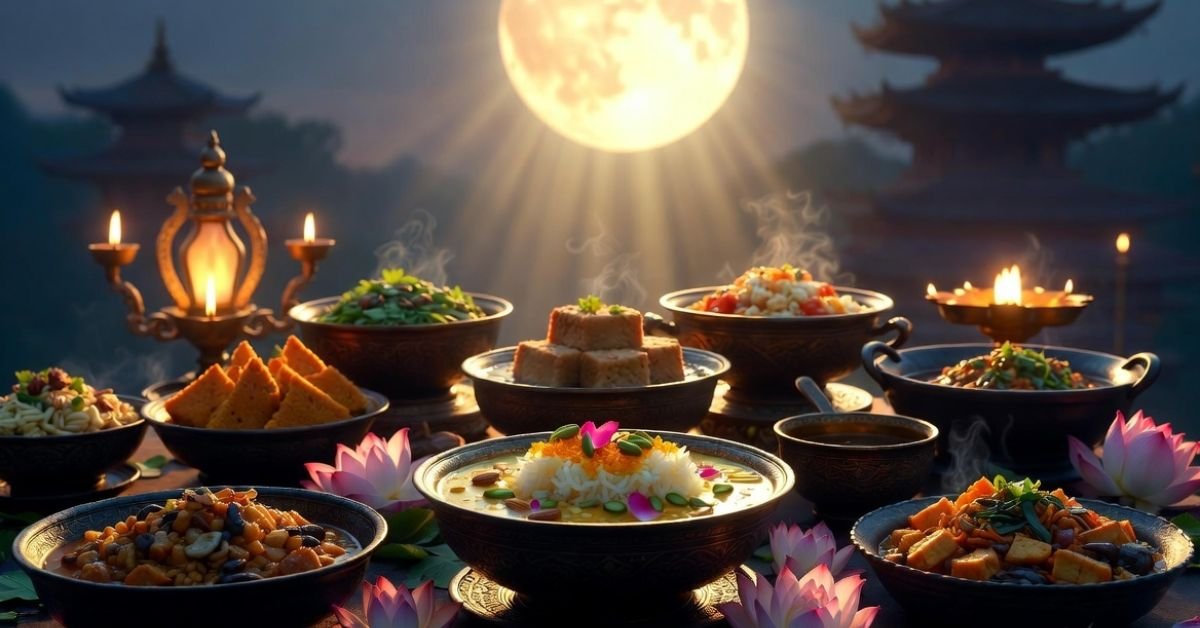

As millions across Asia mark Buddha Purnima today, the full-moon day commemorating the birth, enlightenment, and Mahaparinirvana of Gautama Buddha, food takes center stage not as lavish feasting but as an expression of ahimsa (non-violence), generosity, and spiritual reflection.
From simple milk-rice puddings in South Asia to temple-style vegetarian banquets in East Asia, the day’s culinary customs reflect core Buddhist teachings of mindfulness and dana, the practice of selfless giving.
In India and Nepal, where the festival is observed as Buddha Jayanti, families and temples prepare kheer, a creamy rice pudding made with milk, rice, sugar or jaggery, nuts, saffron, and cardamom, as the centerpiece.
The dish directly recalls the legend of Sujata, the village woman who offered Buddha milk porridge, helping him regain strength before his enlightenment under the Bodhi tree.
Devotees offer kheer to Buddha statues and monks before distributing it as prasad.
Other sattvic (pure, non-onion, non-garlic) dishes such as khichdi, sabudana khichdi, or regional variations like Bengali mishti chaler payesh and Odia pithas (steamed rice cakes) are also common, emphasizing light, vegetarian meals that promote clarity and compassion.
Sri Lanka’s Vesak celebrations feature kiribath, milk rice cooked in coconut milk, traditionally molded into diamond shapes and served with seeni sambol or lunumiris.
Community dansalas (free food pavilions) set up along roadsides serve vegetarian rice, curries, sweets, and refreshments to thousands of passersby, turning the act of cooking and sharing into a public expression of merit-making.
In Indonesia, Waisak observances at Borobudur Temple and across the archipelago include symbolic dishes such as bubur merah putih (red-and-white rice porridge representing courage and purity) and kue burgo (rice-flour crepes in coconut milk).
Lotek, a boiled vegetable salad with peanut sauce, adds a fresh, plant-based element to temple offerings.
Thailand’s Visakha Bucha Day and similar observances in Myanmar, Cambodia, and Laos see temples and homes preparing vegetarian versions of local favorites, coconut-based sweets like khanom tom or kanom krok, fresh fruit platters, and mild curries.
Many Thais observe temporary vegetarianism or veganism for the day, with morning alms-giving to monks forming the heart of the tradition.
Further east, South Korea’s Bucheonim Oshinnal highlights temple cuisine with sachal bibimbap, mixed rice topped with mountain vegetables in five colors symbolizing the universe, alongside shiitake broths, lotus root dishes, and japchae.
In Chinese communities, Buddha’s Delight (Luohan Zhai), a complex vegetarian stew featuring mushrooms, tofu, and an array of vegetables, is widely prepared.
At the same time, Japan’s Hana Matsuri and Vietnam’s celebrations favor shojin ryori-style plant-based meals that embody monastic simplicity.
Across all regions, meat, alcohol, and pungent spices are traditionally avoided, underscoring the principle of non-harm.
Food is cooked not for personal indulgence but for offering to monks, temples, and the public, a living reminder of Buddha’s teachings on generosity and interdependence.
“These dishes are more than recipes; they are acts of mindfulness,” said a senior monk at a major temple in Lumbini, Nepal.
“When we share kheer or kiribath, we remember Sujata’s kindness and Buddha’s path.”
As Buddha Purnima unfolds under the full moon, the shared tables from the Himalayas to the Java Sea illustrate how one ancient story continues to nourish both body and spirit in diverse cultural expressions.
In an increasingly connected world, these culinary traditions serve as a gentle invitation to pause, reflect, and practice compassion, one vegetarian meal at a time.
About Author