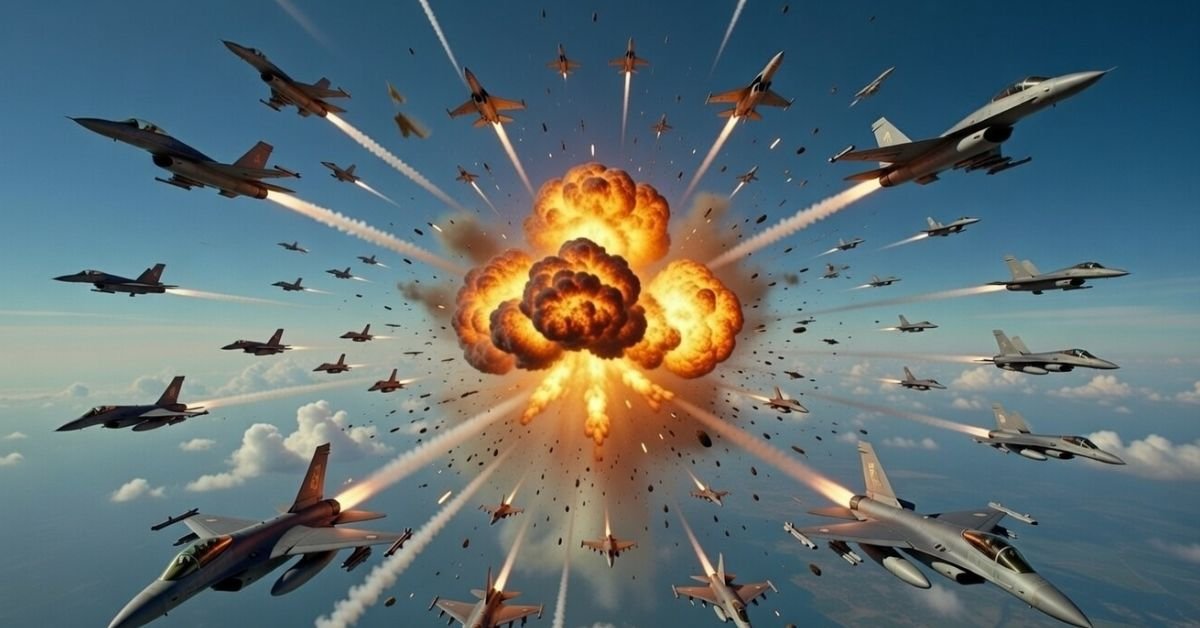

The war between the United States, Israel, and Iran has entered its second week, showing no immediate signs of resolution as airstrikes intensified overnight, targeting key infrastructure in Tehran and beyond.
Iran retaliated with missile barrages against Gulf allies, including Saudi Arabia, the UAE, and Qatar, escalating fears of a broader regional crisis.
US President Donald Trump has reiterated demands for Iran’s “unconditional surrender,” firmly rejecting any diplomatic overtures short of total capitulation.
Dubbed “Operation Epic Fury” by US military officials, the conflict ignited seven days ago with coordinated US-Israeli airstrikes deep inside Iranian territory, amid long-simmering Middle East tensions.
In the latest phase, the Israeli Air Force mobilized over 80 fighter jets for a “broad-scale” assault on Tehran and central Iran, aiming to dismantle Iranian military assets.
Iran’s Islamic Revolutionary Guard Corps (IRGC) countered with the 25th wave of its “Operation True Promise 4,” deploying advanced Ghadr ballistic missiles and Fattah hypersonic missiles toward Israeli and US positions.
Iranian forces have also unveiled the Khorramshahr-4 ballistic missile, codenamed “Kheibar,” capable of striking targets up to 2,000 km away with a payload of 1,500–1,800 kg, heightening concerns over potential strikes on distant allies.
Retaliatory attacks have inflicted significant damage on infrastructure in Saudi Arabia, Doha, and Dubai, though regional air defense systems intercepted many inbound projectiles.
Additionally, explosions disrupted operations at Tehran’s international airport, compounding chaos in civilian and military logistics.
US commanders report having neutralized over 3,000 Iranian targets in the initial week, prioritizing military installations, nuclear sites, and command hubs.
From the White House, President Trump declared, “We want to pick a President that’s not leading their country into war,” while hinting at efforts to undermine Iran’s leadership structure amid signs of internal discord.
The humanitarian impact is profound and growing.
At least six US service members have been killed, contributing to a regional death toll now in the thousands.
Iranian sources estimate over 1,300 domestic casualties.
The conflict has spilled into neighboring Lebanon, where bombings persist, and reports indicate Russian intelligence support for Iranian operations against US forces.
Global economic fallout is swift and severe.
Disruptions in the Strait of Hormuz and attacks on Gulf facilities have driven oil and gas prices to record highs, with experts predicting sharp increases in fuel costs in markets like India.
The Pentagon anticipates seeking billions in congressional funding for sustained operations, drawing bipartisan scrutiny amid proposed cuts to domestic programs like healthcare.
Within Iran, reactions are polarized.
Protests have flared in major cities, with demonstrators burning symbols of Western intervention and chanting anti-Israel slogans.
Conversely, critics from the Iranian diaspora and internal dissidents attribute the crisis to the regime, amplifying calls for political overhaul via social media.
Iran’s president has publicly apologized amid mounting domestic pressure, yet the government vows preparedness against any ground invasion.
International responses are diverse.
China emerges as a possible mediator, leveraging its resources and perceived neutrality, though no formal role has materialized.
The UK is mobilizing an aircraft carrier for potential deployment, despite US denials of such coordination.
On social platforms, the situation fuels a mix of alarm and irony, with trending hashtags like #WWIII and #IranWar spawning memes and commentary.
As strikes continue unabated and diplomatic channels remain stalled, global leaders call for de-escalation.
The Middle East teeters on the edge of further instability, with developments unfolding rapidly.
Stay tuned for ongoing coverage.
About Author