
Table Of Contents
Breaking News: Latest Turquoise Alert Issued In Mesa For Missing Teen
Early this morning on November 2, 2025, residents across Arizona were jolted awake by their phones blaring a loud notification.
It was not an Amber Alert for a child abduction or a Silver Alert for a wandering senior; it was a Turquoise Alert AZ, the state’s newest emergency broadcast system designed to locate missing and endangered individuals.
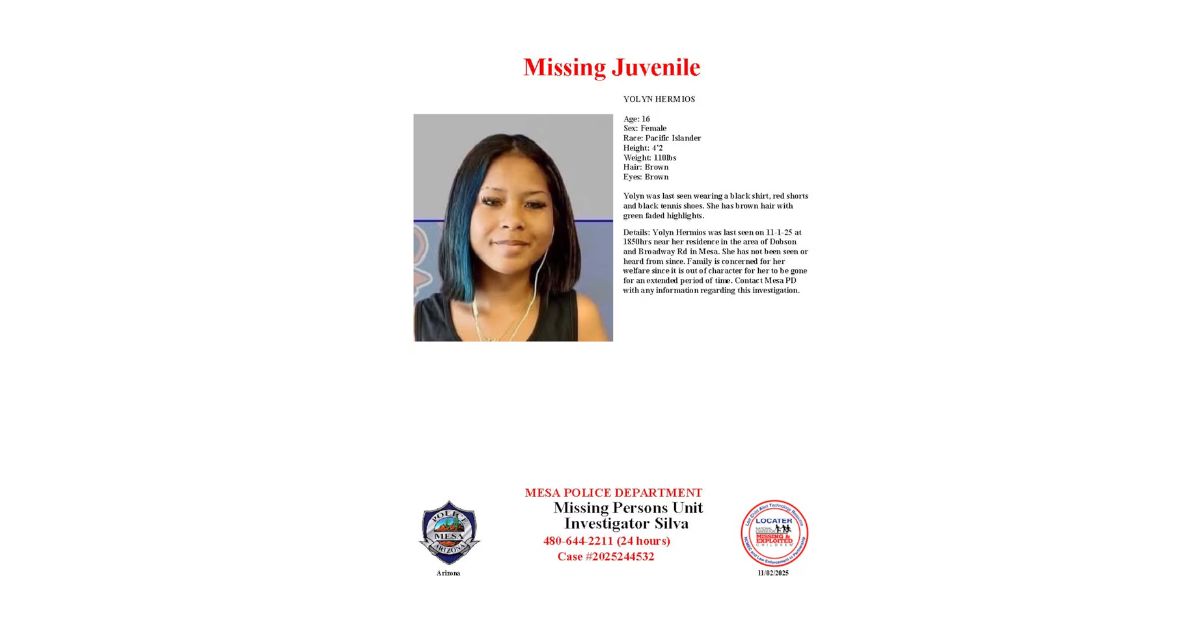
The alert focused on 16-year-old Yolyn Hermios, a Pacific Islander girl last seen on foot near Dobson and Broadway Roads in Mesa around 6:50 pm the previous evening.
Described as 4 feet 2 inches tall, weighing 110 pounds, with brown eyes and brown hair featuring faded green highlights, Yolyn was wearing a black shirt, red shorts, and black shoes when she disappeared.
The Mesa Police Department, in coordination with the Arizona Department of Public Safety (DPS), activated the Turquoise Alert after determining that local search efforts had been exhausted and her disappearance involved unexplained circumstances that could place her in danger.
As of this writing, the search is ongoing, and authorities urge anyone with information to call 911 or Mesa PD immediately.
This incident marks one of the few activations of the Turquoise Alert since its launch earlier this year, highlighting its role in bridging gaps left by other systems, such as the Amber Alert Arizona program.
If you are wondering, “What is Turquoise Alert?” you are not alone.
Many Arizonans received this alert for the first time today, sparking questions and some frustration at an early hour.
However, this system represents a significant step forward in public safety, particularly for vulnerable populations.
In this in-depth article, we will examine the origins, mechanics, and impact of the Turquoise Alert AZ, drawing on recent events, official statements, and data to provide a clear and straightforward guide.
We will also compare it to familiar systems like Amber Alert Arizona, delve into the broader crisis of missing persons in the state, and offer practical advice for how you can help.
What Is Turquoise Alert? A Simple Explanation
At its core, the Turquoise Alert is an emergency notification system that alerts the public when a vulnerable person goes missing under suspicious or unexplained conditions.
Unlike more well-known alerts, it is specifically tailored for individuals who do not fit the criteria of child abductions (Amber) or elderly disappearances (Silver).
Launched in July 2025 by Arizona Governor Katie Hobbs, the system aims to mobilize communities quickly, utilizing everything from phone notifications to highway signs to disseminate information.
The name “Turquoise Alert” holds cultural significance.
Turquoise is a sacred stone in many Indigenous cultures, symbolizing protection, healing, and connection to the land.
This choice reflects the alert’s origins in addressing the disproportionate number of missing Indigenous people in Arizona, though it has been expanded to help anyone meeting the criteria.
Governor Hobbs described it as “a critical communication tool that will save lives,” emphasizing its role in rapid response when every second counts.
To activate a Turquoise Alert AZ, law enforcement must confirm five key conditions:
- A missing person report has been filed and entered into official databases.
- The individual is under 65 years old.
- All local search resources have been used up.
- The disappearance is unexplained (with no apparent reason, such as a planned trip) or suspicious (suggesting possible foul play).
- There is sufficient descriptive information, such as photos, last known location, or vehicle details, to help the public assist in the recovery.
Once approved by DPS, the alert blasts out through multiple channels:
Wireless Emergency Alerts (those loud phone tones), the Emergency Alert System on TV and radio, social media posts from agencies, digital highway signs managed by the Arizona Department of Transportation (ADOT), and all-points bulletins to other law enforcement.
This multi-pronged approach ensures broad reach, even in rural or tribal areas where cell service might be spotty.
Why create a new alert?
Arizona already has robust systems, but gaps exist.
For instance, Amber Alert Arizona requires evidence of abduction and immediate danger to a child under 18, while Silver Alerts (soon to be renamed SAFE Alerts) focus on those 65 and older with cognitive impairments.
The Turquoise Alert fills the middle ground, covering adults and teens who may be at risk but do not qualify for other alerts.
It is also inclusive of tribal members, responding to calls from Indigenous leaders for better tools to combat the Missing and Murdered Indigenous People (MMIP) crisis.
The History Behind Turquoise Alert: From Tragedy To Legislation
The story of the Turquoise Alert begins with heartbreak and advocacy.
It is officially known as “Emily’s Law,” named after Emily Pike, a 14-year-old girl from Arizona whose 2022 disappearance and tragic death exposed flaws in the existing alert systems.
Emily ran away from home, but her case did not meet Amber Alert criteria because there was no confirmed abduction.
By the time authorities located her, it was too late.
Her family, along with advocates, pushed for change, arguing that all missing children and vulnerable people deserve urgent attention regardless of labels like “runaway.”
In response, Arizona lawmakers introduced House Bill 2281 in early 2025.
Sponsored with bipartisan support, the bill established the Turquoise Alert System specifically for missing tribal members aged 18 to 64, but discussions expanded its scope to include any endangered person under 65.
Governor Katie Hobbs signed it into law in May 2025, and thanks to proactive work by her office and DPS, the system went live in July, ahead of the official effective date.
Tribal leaders played a pivotal role. Paul Russell, President of the Inter Tribal Council of Arizona, called it “a proactive step in the right direction” for communities long plagued by the MMIP crisis.
Navajo Nation President Buu Nygren echoed this, noting it as “a vital tool” to reunite families.
The Governor’s Office also developed an eight-course training program for law enforcement, covering cultural sensitivity, alert activation, and best practices for missing persons cases involving tribal lands.
This legislation did not happen in a vacuum.
Arizona has been grappling with high rates of missing persons for years.
In 2022, the state ranked third nationally for Indigenous missing persons cases, with over 90 Native Americans reported missing since the Turquoise Alert’s launch alone.
The MMIP epidemic affects Native women and girls disproportionately, with rates of violence and disappearance far exceeding the general population.
Advocates point to systemic issues, including jurisdictional challenges among state, federal, and tribal authorities, underfunding of reservations, and a history of mistrust in law enforcement.
Comparing Arizona’s Alert Systems: A Handy Table
To understand the Turquoise Alert’s place within Arizona’s four central DPS-managed alert systems, let us break down each system.
Each serves a unique purpose, but they all aim to capture the public’s attention and support for swift resolutions.
| Alert | Purpose | Age | Criteria | Channels |
|---|---|---|---|---|
| Amber Alert Arizona | For abducted children in immediate danger. | Under 18 | Confirmed abduction, imminent harm, descriptive info available. | Phone alerts, TV/radio, highway signs, social media. |
| Silver Alert (soon SAFE Alert) | For missing seniors or those with cognitive disabilities like dementia. | 65+ or any age with impairment | Wandering due to condition, local resources exhausted. | Same as above, plus targeted broadcasts. |
| Blue Alert | To apprehend suspects who have harmed or threatened law enforcement. | N/A (focus on suspects) | Officer killed/injured, suspect at large with description. | Public alerts to aid capture. |
| Turquoise Alert AZ | For missing endangered persons under unexplained/suspicious circumstances. | Under 65 | Local resources exhausted, suspicious/unexplained disappearance, danger likely, info available. | Phone, TV/radio, highway signs, law enforcement bulletins. |
As you can see, the Turquoise Alert AZ serves as a catch-all for cases that fall between the cracks, such as vulnerable adults or teens who may be coerced or lost, and do not fit into child-specific rules.
For example, while Amber Alert Arizona has strict requirements for abductions, Turquoise allows for broader “endangered” scenarios, making it more flexible.
The MMIP Crisis In Arizona: Why Turquoise Alert Matters
Arizona’s landscape is vast and diverse, home to 22 federally recognized tribes that cover approximately 27% of the state.
However, this beauty hides a dark reality: the Missing and Murdered Indigenous People crisis.
According to 2025 data from the National Missing and Unidentified Persons System, Arizona ranks third in the U.S. for missing Indigenous persons, behind only Alaska and California.
Over 90 Native Americans have been reported missing in the state this year alone, with women and girls making up a staggering portion, often victims of violence, trafficking, or exploitation.
The crisis stems from deep-rooted issues. Reservations often lack adequate policing, with federal jurisdiction complicating investigations.
Poverty, substance abuse, and domestic violence exacerbate risks.
A 2017 study by the Urban Indian Health Institute found Arizona had the third-highest number of missing and murdered Indigenous women and girls, with many cases unsolved due to poor data collection.
Families report feeling ignored, with disappearances dismissed as “runaways” without thorough follow-up.
The Turquoise Alert AZ directly tackles this by prioritizing tribal members in its criteria and encouraging tribal law enforcement to request activations.
Gila River Indian Community Governor Stephen Roe Lewis praised it as “deeply meaningful,” noting how Indigenous people “slip through the cracks of systems not built to protect them.”
Since launch, nearly 300 people have been reported missing statewide, but only a handful qualified for Turquoise Alerts, by design, to avoid alert fatigue.
Take Jamie Yazzie, a Navajo woman missing since 2019; her case gained attention through billboards and advocacy, but predated the alert.
Today, systems like Turquoise could amplify such efforts faster.
Experts, such as those from the Wassaja Center at Arizona State University, stress the importance of education and community involvement in reducing these numbers.
Success Stories: How Turquoise Alert Has Made A Difference
Despite being new, the Turquoise Alert has already proven its worth.
The first activation occurred on July 24, 2025, for 6-year-old Violet Coultas from Hawaii, whom her non-custodial mother took.
Spotted at Phoenix Sky Harbor Airport, they were located at a Cottonwood women’s shelter within hours, safe and sound.
DPS credited the alert’s wide dissemination for the quick resolution, noting it bridged the gap for cases that did not fit the Amber criteria.
Just days ago, on October 30, 2025, another Turquoise Alert was issued for 16-year-old Chandler Ikard from Peoria, last seen near 95th Avenue and Beardsley Road.
Described as 5 feet 9 inches tall, 140 pounds, with brown hair and eyes, wearing a black and gray vest, he was found safe shortly after, leading to the cancellation of the alert.
Today’s alert for Yolyn Hermios underscores the system’s ongoing relevance.
While outcomes vary, these examples show how public awareness can turn the tide.
DPS reports that even denied requests prompt thorough reviews, ensuring no case is overlooked.
Public Reaction: Praise, Complaints, And Lessons Learned
Not everyone was thrilled with the 5:20 am start today.
Turquoise Alert. Social media lit up with complaints about the timing.
One user tweeted, “There is a special place in hell for whoever ran that turquoise alert at 5:25 am in the middle of my sleep.”
Another said, “AZDPS scaring the fuck out of me at 5 am with a Turquoise alert… Do I gotta start investigating rn?” Some even turned off alerts altogether, citing the “cry wolf effect.”
Critics argue that the system risks desensitizing people if it is overused or timed poorly.
However, supporters point out that lives are at stake, and delaying for convenience could be deadly.
DPS explains that alerts are timed for maximum impact, often immediately upon approval, to catch potential witnesses.
In response to feedback, agencies are considering refinements, like regional targeting.
On the positive side, posts like those from local news outlets urged sharing: “Turquoise Alert issued for teen girl last seen in Mesa.”
This community engagement is key to the alert’s success.
Challenges And The Road Ahead
While promising, the Turquoise Alert faces hurdles.
Strict criteria mean that many cases, such as runaways without clear danger, do not qualify, which can be frustrating for the families involved.
Over 278 missing persons reports since July met the age threshold, but only a few activations occurred.
Advocates push for broader definitions, especially for minors.
Training is another focus.
The Governor’s eight-module program educates officers on cultural competency and MMIP protocols, but rollout takes time.
Future enhancements may include improved integration with federal systems or the use of AI for faster data analysis.
Arizona’s overall missing persons rate is high, second per capita nationally, with 12.28 per 100,000 residents.
Addressing root causes like poverty and violence will require more than alerts; it needs policy changes and funding.
Helpful Tips: What You Can Do When You See A Turquoise Alert
Receiving a Turquoise Alert AZ?
Here is how to respond effectively:
- Read Carefully: Note the description, location, and any vehicle info.
- Stay Alert: If you are in the area, keep a lookout without putting yourself in danger.
- Report Sightings: Call 911 immediately, do not approach the person.
- Share Responsibly: Repost official info on social media, but avoid speculation.
- Customize Notifications: Adjust your phone settings to receive alerts at a lower volume if needed, but do not disable them altogether.
- Educate Yourself: Learn about MMIP through resources like the Arizona Luminaria database.
By staying engaged, you become part of the solution.
Conclusion: A Beacon Of Hope For Arizona’s Vulnerable
The Turquoise Alert AZ, championed by Governor Katie Hobbs, is more than a notification; it is a lifeline for those who might otherwise be forgotten.
From its roots in the MMIP crisis to recent activations like Yolyn Hermios’, it underscores Arizona’s commitment to safety for all.
While challenges remain, this system, alongside Amber Alert Arizona and others, empowers communities to act swiftly and effectively.
As we monitor the search for Yolyn, remember: Awareness saves lives. If you have info, speak up.
Together, we can make Arizona a safer place to live.
For updates, check official DPS sources or local news.
About Author